Advertisement
Google Ad Slot: content-top
PHP Form Validation
Form validation is an important part of any web application to ensure that user input is correct and secure. In PHP, form validation can be performed using server-side scripting to check for required fields, proper data formats, and prevent malicious input.
Steps to Validate a Form:
- Check if the form is submitted.
- Validate required fields.
- Validate data format (email, numbers, etc.).
- Display error messages.
- Retain user input after form submission.
Example of PHP Form Validation
PHP Form Validation Example
Form Submitted Successfully"; echo "Name: " . $name . ""; echo "Email: " . $email . "
"; echo "Gender: " . $gender . "
"; } ?>
Explanation:
$_SERVER["REQUEST_METHOD"] == "POST"
- Checks if the form was submitted via POST method.
2. Sanitization (test_input())
trim()removes extra spaces.stripslashes()removes backslashes.htmlspecialchars()prevents XSS attacks.
3. Validation Logic
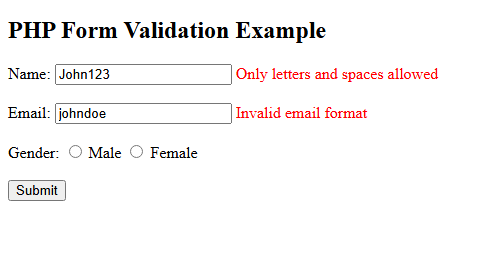
- Name: Ensures it's not empty and only contains letters/spaces.
- Email: Checks if it's a valid email format.
- Gender: Ensures a selection is made.
4. Displaying Errors
- If validation fails, an error message is displayed next to the field.
5. Retaining User Input
- The
value="<?php echo $name; ?>"ensures the input is not lost on form submission.
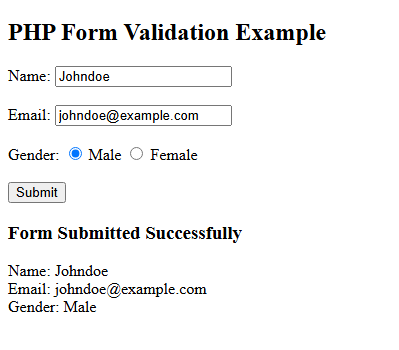
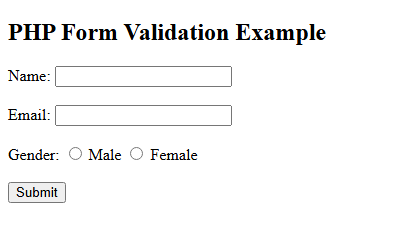
Output Example:
Before Submission:
After Submission (Invalid Input Example):
After Successful Submission: